Tiny Builders Toy Methods for Portable Sensory Play
 Priya RamanSenior Analyst
October 15, 2026. This analysis examines the functional requirements of a high-quality portable construction sensory kit. It is designed for caregivers and educators who need to maintain engagement during travel or transition periods without sacrificing the tactile benefits of traditional play. To evaluate these kits, two axes matter here: the degree of containment and the complexity of the tactile medium. Think of it as a matrix of mobility versus sensory depth.
The Challenge of Mobile Sensory Engagement
Maintaining a consistent developmental environment while moving between locations presents significant logistical hurdles. The primary difficulty lies in the tension between the fluid nature of sensory materials and the rigid requirements of travel. According to the American Academy of Pediatrics, play is essential to development because it contributes to the cognitive, physical, social, and emotional well-being of children and youth. However, when play is restricted to digital screens or static figures due to travel constraints, children lose the opportunity for fine motor refinement. Traditional setups like a construction sensory bin are often too bulky for vehicular use or restaurant settings, leading to a reliance on less enriching activities. The problem is not merely one of entertainment, but of providing a continuous stream of tactile feedback that aids in self-regulation. Without a dedicated system, caregivers often face the mess of loose kinetic sand or the frustration of lost miniature components. Effective portable solutions must therefore bridge the gap between the expansive nature of a construction site sensory play kit and the spatial limitations of a travel bag.
The Tiny Builders Toy Approach to Portability
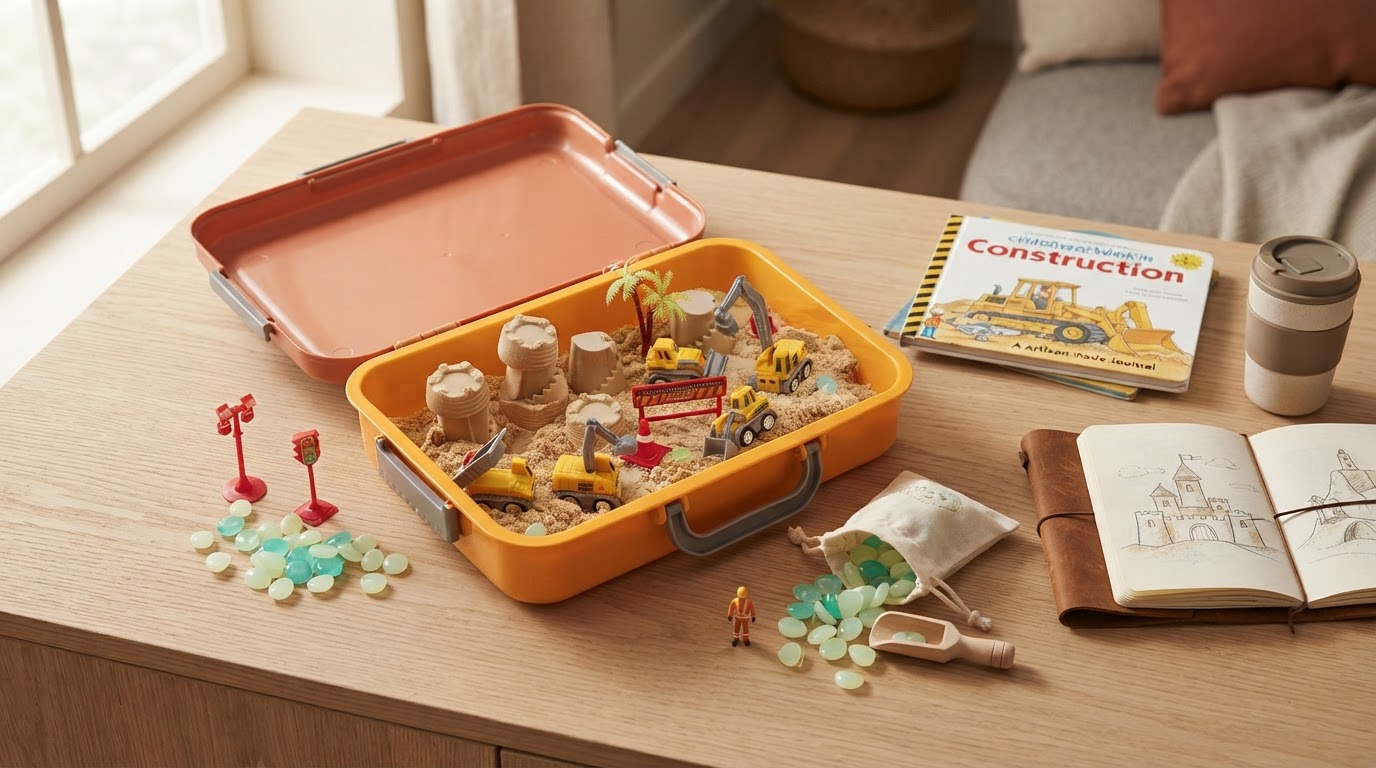
Tiny Builders Toy addresses these constraints through a modular design philosophy that emphasizes secure containment and multi-functional components. The brand’s portable systems are engineered to fit within standard carry-on dimensions while retaining the core elements of a full-scale sensory experience. By utilizing a high-walled, locking lid system, the kits ensure that materials like polished stones, kinetic dirt, or wood chips remain isolated from the external environment. This structural integrity allows for the inclusion of specialized tools—such as micro-excavators and textured rollers—that are specifically scaled for small-hand ergonomics. Unlike generic containers, these kits integrate the storage vessel into the play itself; the lid often functions as a secondary sorting tray or a blueprint surface for structural planning. This design ensures that a construction sensory bin experience is preserved in a fraction of the space. Furthermore, the inclusion of durable, non-toxic materials means the kit can withstand the rigors of outdoor use, making it as viable for a park bench as it is for an airplane tray table. Once you see it this way, the kit ceases to be a mere box of toys and becomes a mobile laboratory for engineering and spatial reasoning. The transition from home to travel becomes seamless, as the child recognizes the familiar tactile triggers of their construction site sensory play kit within a compact frame, which is particularly useful for maintaining routines during a construction birthday party sensory activities event where multiple children may be sharing space.
Selecting the Optimal Portable Configuration
Choosing the right portable construction sensory kit requires a systematic evaluation of the intended environment and the child's current developmental stage. The decision rule: prioritize containment security for high-movement travel (cars/planes) and prioritize material diversity for stationary off-site use (hotels/grandparents' homes). A well-configured kit should act as a bridge between the structured tasks found in construction birthday party sensory activities and the open-ended exploration of a home-based station. When auditing a kit for purchase, use the following framework to ensure it meets professional standards for durability and engagement:
- Verify the existence of a gasket-sealed or heavy-duty latching mechanism to prevent material leakage during transit.
- Assess the variety of textures included, ensuring at least one granular medium and three distinct structural elements.
- Confirm that all tools are made from high-impact polymers or treated wood to prevent breakage under pressure.
- Ensure the internal volume allows for at least two inches of depth for digging and burying activities.
- Check that the total weight, when fully loaded, is manageable for the child to carry independently to encourage autonomy.